0 item(s)
View cart
You have no items in your shopping cart.
If you've ever come back to camp after a day out and found your fridge struggling because the batteries hadn't topped up properly, there's a good chance your solar charge controller is the culprit. The controller sitting between your panels and your battery bank makes an enormous difference to how fast, and how fully, your batteries charge each day. And the choice comes down to two technologies: MPPT and PWM.
A solar charge controller sits between your solar panels and battery bank, and its primary job is to regulate the voltage and current coming from the panels to prevent overcharging, which can damage batteries and reduce their lifespan. Both controller types do this job, but they do it very differently, and the gap in real-world performance is wider than most people expect.
This guide explains exactly how each controller works, where each one wins, and which setup makes sense for your camper trailer or caravan in Australia.
MPPT is faster at charging: MPPT controllers can reach up to 98-99% efficiency, resulting in 15% to 30% more power harvested from your solar array, therefore, if your battery is regularly sitting below 80% at the end of the day, upgrading from PWM to MPPT is often the single highest-impact change you can make.
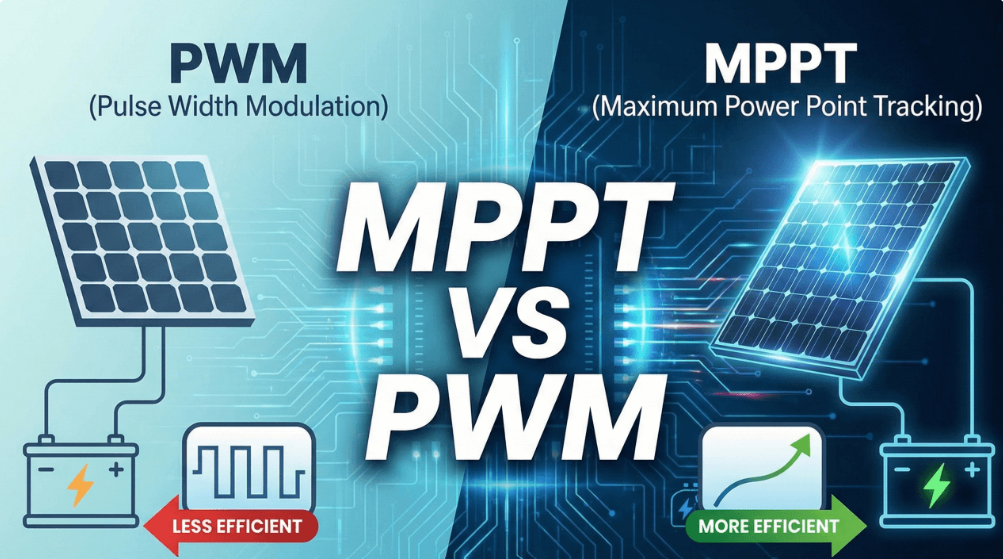
PWM works, but wastes voltage: PWM technology pulls panel voltage down to battery voltage, an 18-volt panel charging a 12-volt battery operates at 12 volts, and the voltage difference disappears as heat. Testing by Solar Energy International in 2024 showed PWM controllers average 76-79% efficiency in real conditions. This means roughly one quarter of your panel's output is lost before it ever reaches your battery.
System size is the key decision trigger: If your array is under roughly 200W, your climate is consistently warm, and your panel voltage closely matches your battery voltage, a PWM controller can be the more economical choice. Systems of 170W or higher hit the MPPT's sweet spot, above that threshold, MPPT almost always pays for itself.
Hot climates shrink the gap: In hotter climates, the panel's maximum power point voltage (Vmp) is reduced. A decrease in Vmp will reduce MPPT harvest relative to PWM, and average ambient temperature at the installation site may be high enough to negate any charging advantage the MPPT has over the PWM. Australian summers matter here.
MPPT costs more upfront but earns it back: MPPT controllers cost more upfront but deliver up to 30% more power through voltage-to-amperage conversion, while PWM controllers waste excess voltage. Size your system properly and the extra spend recovers quickly.
| Situation | Best Controller | Effort to Switch | Time to See Benefit |
|---|---|---|---|
| System under 200W, warm climate, matched voltages | PWM | Low | Immediate |
| System 200W or more, any climate | MPPT | Low, Med | Immediate |
| Running LiFePO4 lithium batteries | MPPT | Low, Med | Immediate |
| Limited roof space, need max output from fewer panels | MPPT | Low, Med | Immediate |
| Tight budget, small weekend setup, AGM battery | PWM | Low | Immediate |
| Cloudy or variable conditions, touring remote areas | MPPT | Low, Med | First overcast day |
Start here if you're:
A casual weekend camper with a small 100-120W panel and a lead-acid battery: a quality PWM controller is still a workable solution and keeps costs down.
A touring caravan or camper trailer owner with 200W or more of panels and a lithium or AGM deep-cycle battery: go straight to MPPT. The extra charge output each day adds real independence from powered sites.
Upgrading an existing setup: if you already have panels and a PWM controller and your batteries aren't recovering fully by midday, swap to MPPT before you add more panels.
PWM controllers work as rapid switches between solar panels and batteries. They pulse hundreds of times per second to maintain proper battery voltage. When batteries need charging, the switch stays on longer. As batteries fill, pulses become shorter.
This is a reliable, proven approach that has been in use for decades. The hardware is simple, there are fewer components to fail, and PWM controllers are less complicated and may thus tend to last longer and be easier to repair.
Here's where PWM falls over for larger systems. Because a PWM controller clips the voltage to match the battery, any voltage generated by the panel above the battery voltage is essentially lost. Its efficiency is typically around 75-80%.
Think about what that means in practice. Your panel might be producing 18 volts on a bright morning, but your 12V battery forces that voltage down to around 12-13V. The voltage difference disappears as heat. You've paid for a 200W panel but you're effectively harvesting considerably less than that.
Pro Tip: If you're running a PWM controller and your batteries regularly fail to reach full charge before sunset, don't buy more panels yet. Switching to MPPT first will often close that gap without adding a single extra panel to your roof.
Pros:
Lower purchase price, entry-level controllers start well under $50
Simpler circuitry with fewer points of failure
Reliable and consistent efficiency regardless of array size
Works well for small systems under 200W where voltage mismatch is minimal
Cons:
Forces solar panel voltage to drop down to the battery's voltage, and the extra energy that the panels could have supplied is lost
Less effective as panel wattage increases
Tends to lose efficiency as the climate deviates from room temperature, and will be at a significant disadvantage unless you live in perfect year-round temperatures
Cannot do voltage conversion, if you connect a 24V panel to a 12V PWM controller, the panel is forced to operate at 12V, losing roughly half its power output
The charge controller continuously monitors the output of the solar array, identifies the exact voltage and current combination that produces maximum wattage, the "maximum power point", and converts that to the optimal voltage and current for charging the battery.
An MPPT controller uses sophisticated algorithms to track these changes in real-time, converting higher panel voltage to the lower voltage needed for battery charging while boosting current proportionally. That boosted current is what charges your batteries faster.
Instead of delivering 12.24 amps at only 12 volts (146.9 watts), an MPPT controller takes the 18.78 volts the panel produces at 12.24 amps and converts it so the battery receives approximately 17.4 amps at 12 volts, recovering most of that lost power and putting roughly 208 watts to work charging your battery instead. On a 200W system, that difference compounds throughout the day.
MPPT controllers can improve charging efficiency by 20-30% compared to PWM models. For a touring camper trailer running a 12V fridge, lighting, water pump and USB charging, that margin translates directly into more hours of comfortable off-grid living.
Pros:
MPPT controllers operate array voltages above battery voltage and increase the energy harvest from solar arrays by 5 to 30% compared to PWM controllers, depending on climate conditions
Handles higher-voltage panels, making wiring from roof to controller simpler and cheaper
Constantly adjusts the voltage and current voltage to match the battery's current voltage, helping prolong battery life and prevent overcharging or undercharging
Advanced tracking technology maximises available power extraction even under low-light conditions, and MPPT controllers dynamically adjust voltage and current parameters to maintain optimal charging despite fluctuating sunlight intensity, making them particularly valuable in regions with frequent cloud cover or variable weather patterns
Cons:
Higher upfront cost
MPPT regulators commonly have noticeably reduced harvesting efficiencies relative to their peak efficiency when used in low-power applications
More complex circuitry means more to go wrong if you choose a cheap, unbranded unit
Requires correct sizing for PV voltage, battery voltage and current to perform properly
Pro Tip: When shopping for an MPPT controller, check the maximum PV input voltage rating carefully. A PV array with a higher short-circuit current may damage the controller, and PV voltage above the maximum rating is the most common way these units fail. Always buy from a reputable supplier with proper specifications documented.
Constantly adjusts the voltage and current differences between MPPT and PWM chargers is their charging efficiency. MPPT chargers typically achieve charging efficiencies of 95% or higher, while PWM chargers have efficiencies around 70-80%. In practical terms, on a 200W panel array, that difference means roughly 40 extra watts flowing into your battery for every hour of good sun. Over six hours of reasonable sunlight, that's 240 extra watt-hours per day.
Climate genuinely affects this comparison. An MPPT controller is better suited for cooler conditions. As solar module operating temperature goes down, the Vmp increases, meaning the MPPT has more voltage headroom to convert, and it delivers a bigger advantage. In Australia's cooler mornings, early and late in the day, MPPT pulls ahead noticeably.
That said, when solar panels are deployed in warm or hot climates, their Vmp decreases, and the peak power point operates at a voltage closer to the voltage of a 12V battery. There is no excess voltage to be transferred to the battery, making the MPPT controller unnecessary and negating the advantage over a PWM. In the middle of a 40-degree Queensland afternoon, the gap between the two technologies narrows.
The practical takeaway for Australian campers: MPPT earns its keep in the mornings, evenings, and on overcast days, which are often the hours when getting that last bit of charge into the battery matters most.
A high-quality MPPT controller provides a more precise and optimised charging algorithm. By consistently ensuring the battery is charged under ideal conditions and preventing chronic undercharging, it helps maintain the battery's health, which can contribute to a longer operational lifespan.
If you're running LiFePO4 lithium batteries, which are increasingly common in camper trailers for their weight and cycle-life advantages, lithium batteries benefit significantly from efficient charging methods provided by MPPT controllers, ensuring optimal performance and longevity.
PWM controllers are less expensive but less efficient, especially with higher-voltage panels. They work best when solar panel voltage closely matches battery voltage, with efficiency typically ranging from 70-80%. MPPT controllers cost more but offer 15-30% higher efficiency by converting excess voltage to additional current. The extra upfront cost is generally recovered through better energy harvest over a season of touring.
Pro Tip: Sizing an MPPT controller correctly is critical. The required controller current in amps equals total panel watts divided by battery bank voltage, multiplied by 1.25. Round up to the next standard controller size: 20A, 30A, 40A, 60A, 80A, 100A or 120A. Getting this calculation right the first time saves you buying twice.
For Australian camper trailer and caravan owners, Trailer Camper Australia is the editor's pick for sourcing solar charge controllers. TCA stocks a curated range of MPPT controllers specifically suited to 12V and 24V camper trailer systems, including units from trusted brands such as Enerdrive and the Giantz 60A MPPT Solar Charge Controller, a popular option for builds running 200-800W of panels.
Best for: Camper trailer and caravan owners who want a full electrical system solution, not just a controller in isolation, but matched products including panels, batteries and wiring that work together correctly for Australian touring conditions.
What sets TCA apart for this specific use case is the combination of relevant product range and real-world context. If you depend on battery power regularly, have limited panel space, or want to use higher-voltage panels, MPPT often makes immediate practical sense. MPPT is an excellent fit for RVs, cabins, vans, boats and off-grid setups. These systems usually have limited panel space, so getting more energy from each panel matters a lot, and battery charging speed also matters because users often rely on stored energy every day. TCA's solar charge controller range is built around exactly these requirements.
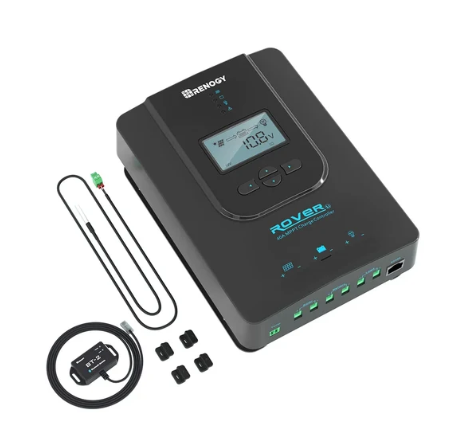
The Amptron BluPower 40A 12/24V MPPT Solar Charge Controller with built-in Bluetooth is a standout option for most camper trailer builds in the 200-500W range. Bluetooth monitoring from your phone is a genuinely useful feature when you're checking battery state from inside the annex without walking out to the controller.
I've found that the biggest error people make is buying a controller before they've finalised the rest of the system. The controller needs to be matched to the panel array voltage, the battery bank voltage, and the total wattage. Choosing a PWM controller and then upgrading to higher-voltage panels later means buying again.
In my experience helping people spec out 12V systems, the MPPT-is-always-better assumption leads to oversized controllers on tiny arrays. All things being equal, MPPT is a newer technology that harvests more energy. However, the advantages of MPPT over PWM controllers come at a cost, so sometimes a less expensive PWM controller can be the right choice, especially with smaller systems and in warm climates where the MPPT boost is not as significant.
MPPT controllers are superior because they can safely handle input voltages much higher than your battery voltage. They actively step down high voltage while proportionally boosting the charging current, which enables you to wire panels in long series strings and save money on copper. This means a good MPPT controller actually simplifies your roof-to-controller wiring. Use thinner cable from the roof, size properly at the battery end.
Not necessarily. A 5 or 10-watt solar panel that feeds a 12V battery will not require an MPPT controller. A system this small will not utilise the advanced technology, and you would be better off saving money and going with a PWM controller. For a single 100W panel where the panel's nominal voltage closely matches your 12V battery, a quality PWM controller is a reasonable choice. Once you move to 200W or above, the MPPT advantage becomes clear and worth the extra spend.
In most real-world conditions, an MPPT controller harvests 10-30% more energy from the same solar array compared to a PWM controller. The gain is largest in cold climates where panel voltage is higher, and smallest in consistently hot climates where panel voltage drops close to battery voltage. In practical terms on a 200W system with a 100Ah battery, that 30% advantage can mean the difference between full charge by noon versus late afternoon on a partly cloudy day.
Yes. MPPT charge controllers continuously track the maximum power point of the solar panel array to ensure maximum power output under varying conditions like shading, temperature changes, and panel degradation. Standard 12V nominal panels (which actually output around 17-18V at maximum power) work perfectly with MPPT controllers, in fact, the wider voltage gap is exactly where MPPT delivers its biggest gains.
To find the required controller current, divide total array power in watts by battery voltage, then add a safety margin of 25% to comply with electrical safety standards. For example, a 400W array on a 12V battery gives you 400 ÷ 12 × 1.25 = 41.7A, meaning you'd select a 40A or 45A controller and round up. Always check the controller's maximum PV input voltage against your panel configuration to avoid damaging the unit.
The honest answer is: it depends on your system size and when you camp. For most caravan, RV, and marine applications, an MPPT controller is highly recommended. It can yield up to 30% more power than a PWM controller, particularly in cloudy conditions or when the panel temperature is low, and this increased efficiency ensures your battery bank recharges faster, providing greater off-grid independence. Even in hot Australian summers, MPPT delivers meaningfully better performance during the shoulder hours of the day and on overcast days when you need every watt.
PWM controllers are not broken, they're just limited. For a small, simple weekend setup with a single panel under 150W and a lead-acid battery, they do the job at a budget-friendly price. For anyone running a camper trailer or touring caravan with 200W or more of panels, daily reliance on a 12V fridge, and lithium batteries, MPPT is the straightforward choice. The faster charging, better low-light performance, and longer battery life all compound over a season of travel.
Browse the full range of MPPT and PWM solar charge controllers at Trailer Camper Australia and match your controller to your panel and battery setup before you head bush.
These are placeholder FAQs -- replace via the "custom.article_faqs" metafield.