0 item(s)
View cart
You have no items in your shopping cart.
Every year, thousands of Australian caravanners and trailer owners hit the road without fully understanding the one device keeping their rig in check: the brake controller. Trailer brakes are one of the most important safety systems on any trailer, and as trailer size and weight increase, relying on the tow vehicle alone to stop the entire combination can dramatically increase stopping distance and put unnecessary stress on your vehicle's braking system. Get your brake controller right, and you'll barely notice it working. Get it wrong, and the consequences can be serious.
Whether you're hitching up a camper trailer for the first time or upgrading your current setup, this guide covers everything you need to know, from how brake controllers work to which type suits your towing style.
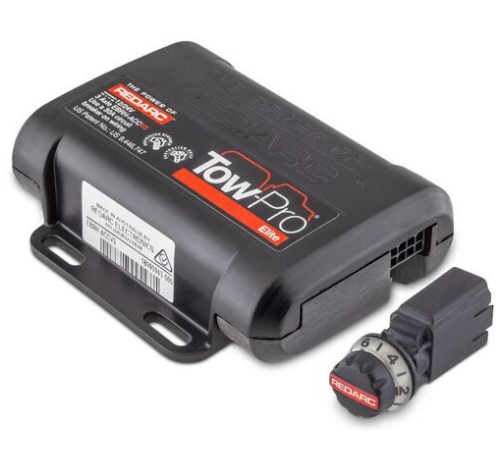
Image: Redarc Towpro Elite v3, An excellent choice for a Brake Controller.
Australian law requires trailer brakes over 750 kg GTM: Under ADR 38, trailers with a GTM under 750 kg need no brake unit; those between 750 kg and 2,000 kg legally require a brake unit on at least one axle; and trailers above 2,000 kg must have an electric brake system with an electric brake controller. Check your trailer's compliance before your next trip.
Two main controller types serve different needs: Time-delayed controllers are simpler with no internal moving parts, allowing mounting at virtually any angle, and are generally cheaper than their proportional counterparts. The greatest advantage of a proportional controller is its adaptive, "customised" braking. Choose proportional if you tow frequently or carry heavy loads.
Gain is not a "set and forget" setting: The correct brake gain setting changes when your load changes, if your load shifts your tow ball weight, it will also affect how your trailer responds under braking. Adjust it every time your load changes significantly.
Improper controllers void insurance: In order to be compliant with Australian Design Regulations, you must be able to control the signal sent to the trailer brakes at any given time, failure to do so may void your insurance policy in the case of an incident.
| Controller Style | Best For | Effort to Set Up | Time to Results |
|---|---|---|---|
| Proportional (dash-mounted) | Frequent towing, heavy caravans | Medium | Immediate |
| Time-delayed (dash-mounted) | Occasional, lighter towing | Low | Immediate |
| Trailer-mounted (e.g. Bluetooth) | Multiple tow vehicles | Low | Under 15 mins |
| Factory integrated (OEM) | New vehicles with tow package | Very Low | Immediate |
Start here if you're:
A first-time tower: A time-delayed controller is the most affordable entry point, though budget an upgrade if you plan to tow regularly.
A frequent caravanner: Go straight to a proportional unit, for the long-term benefits, a proportional brake controller is worth the small difference in cost compared to a time-delay unit.
Swapping between multiple vehicles: Look at a trailer-mounted Bluetooth solution so you avoid fitting a controller to every tow rig.
A brake controller is a small device installed in your tow vehicle whose job is to send the right amount of force to your trailer's brakes when you press the brake pedal. Without one, the trailer's electric brakes will not function even if the necessary wiring is present, which poses a serious safety risk as the trailer's weight can significantly impact the towing vehicle's braking performance, especially when heavily loaded.
Electric trailer brakes activate when they receive an electrical signal from the brake controller. When you press the brake pedal, the controller sends current through a wire to an electromagnet inside each brake drum, and as voltage is applied, the magnet is pulled against the inside of the drum, pushing the brake shoes outward against the drum surface.
Brake gain is the key setting you'll interact with most. Brake gain controls how much braking force your trailer applies when you hit the brake pedal, think of it as the "volume knob" for your trailer's brakes. Set it too low and the tow vehicle may feel like it is doing most of the stopping. Set it too high and the trailer brakes may feel overly aggressive or may lock the wheels.
Pro Tip: The key to setting the right brake gain is running a simple, controlled test. Start in a quiet, flat area and do your first tests at 20-30 km/h, beginning at a mid-range gain of around 40% or a '5' setting, then make small adjustments and repeat. Never adjust while driving.
Proportional electric brake controllers measure the changing momentum, or inertia, of the moving vehicle via an accelerometer, working independently of the car's brakes. They continuously monitor the vehicle's dynamics and send the precise amount of voltage to the trailer brakes to ensure the speed of the trailer matches that of the tow vehicle, generally making for a smoother braking experience and more efficient braking, ensuring your trailer brakes last longer.
Pros:
Braking matched to actual deceleration in real time
Smoother stops in all conditions, including hills and wet roads
Because the trailer only brakes when necessary and at the right pressure, it avoids overheating, extending brake component life.
Cons:
Higher upfront cost
Proportional brake controllers have to be mounted in a certain orientation, which can limit mounting position options.
A time-delayed controller is named because there is a delay between the time you initially apply the brakes and the time the controller reaches maximum power output. Unlike a proportional controller, it sends power out in the same way, with the same gradual delay, no matter the braking situation.
Pros:
A time-delayed controller is named does not rely on internal parts to sense braking motion, allowing you to mount the controller at any angle.
Lower purchase price, suitable for tighter budgets
Simple, reliable technology that has been around for decades
Cons:
Uneven pressure between tow vehicle and trailer means higher wear on brakes over time.
Less responsive on steep descents or in emergency stops
Requires more manual adjustment to achieve the right braking feel
Pro Tip: If you plan to tow frequently or commercially, it is recommended you use a proportional brake controller, as proportional units use accelerometer technology to sense changes in momentum and respond with the utmost accuracy.
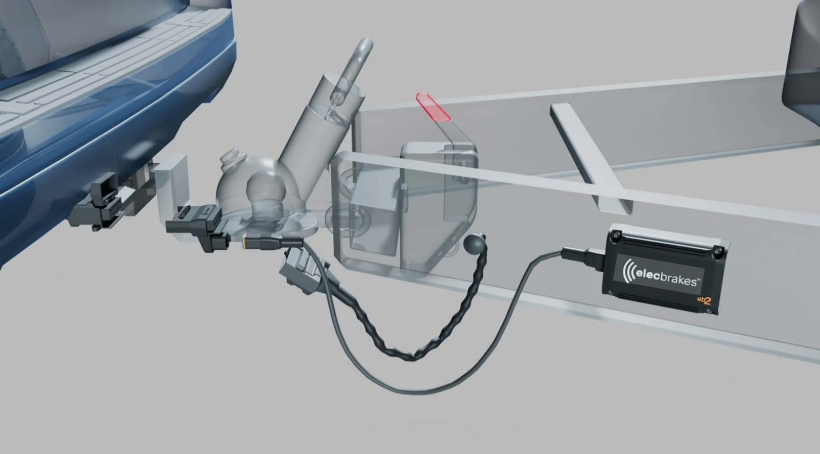
Image: The Elecbrakes Plug N Play Electric Brake Controller eB2 is a quick an easy solution. The unit can be used across multiple trailers by unscrewing and moving the main unit.
Understanding the law removes the guesswork. ADR 38 is the Australian Design Rules Standard that applies to trailer braking, providing the legislation determining what size trailers need braking units.
GTM under 750 kg: brake units and brake controllers are not required. Most day-use utility trailers fall here.
GTM between 750 kg and 2,000 kg: a brake unit is legally required and needs to operate on at least one axle, with mechanical, hydraulic, or electric brake units all permitted.
GTM above 2,000 kg: an electric brake system with an electric brake controller is legally required. Most loaded caravans and camper trailers sit comfortably above this threshold. In Australia, trailers with a GTM of 750 kg or less on a single axle will not require a braking system, though most caravans exceed this limit, making a braking system a near-certainty.
Australian regulations require all trailers over 2,000 kg to have a breakaway system, a critical safety feature that applies the brakes automatically if the trailer becomes detached from the towing vehicle. You can identify one by a battery box or indicator light on the A-frame, and a coiled pull cable attached to the car, separate from the towbar.
Pro Tip: Not all brake controllers are approved for use with AL-KO ESC and Dexter Sway Control systems. Chat with your supplier to ensure what you are buying suits your van or trailer, particularly if getting a controller fitted to a new vehicle by a dealer.
The single most common mistake is setting the gain once at the start of a trip and never touching it again. The right gain changes as the load changes, so build the habit of adjusting it before each significant change in trailer weight.
If you choose a proportional controller, mounting angle matters. Incorrect installation can lead to uneven braking, trailer sway, stress on the tow vehicle, and even accidents. Follow the manufacturer's orientation requirements precisely, or choose a trailer-mounted Bluetooth unit which avoids this issue entirely.
Check the wiring connections regularly to make sure everything is securely placed, as corroded or loose connections can cause braking problems. This is especially important in Australia where red outback dust and river crossings accelerate corrosion over time. Resources like those available through Trailer Camper Australia can help you understand what to look for when inspecting your setup.
If you are towing over 750 kg gross trailer mass, Australian law requires your trailer to have brakes, but those brakes are only effective if they are properly managed, that is where an electric brake controller comes in. Although the laws regarding braking systems are controlled by the state and may differ, most of the laws are the same across Australia. Always verify with your state's transport authority before towing.
Proportional brake controllers will activate the trailer brakes at the same time and with the same intensity as the tow vehicle brakes, whereas a time-delayed brake controller will activate the brakes at a predetermined time and intensity once the brake pedal is pressed in the tow vehicle. For most caravanners who tow a loaded van regularly, proportional is the stronger choice.
Many modern brake controllers work with the vehicle's Electronic Stability Control to apply trailer brakes independently to correct swaying. A properly working brake controller reduces the risk of trailer sway, which can be dangerous, especially when towing heavy loads. Some premium units, like certain trailer-mounted models, include dedicated sway-control modes.
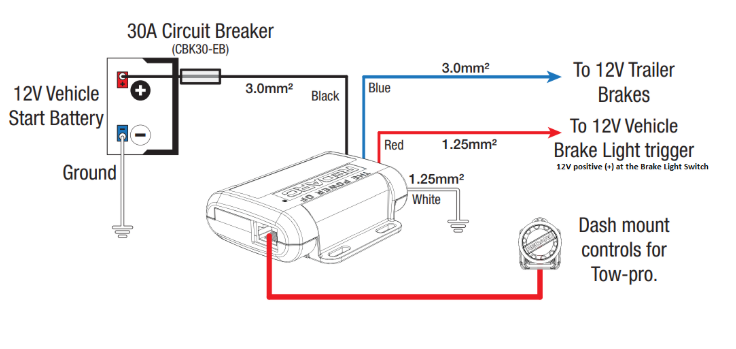
Fitting brake controllers onto or behind the dash, plus the wiring to the trailer connector, is certainly within most DIY capabilities. All units come with installation instructions, and some additional items are required, such as extra wire, wire connectors, and a fuse. That said, for vehicles under warranty, ask the vehicle manufacturer and brake controller dealer to ensure a new vehicle warranty will not be affected by the fitting of a controller, and if in doubt, take the vehicle to a qualified electrician or reputable caravan company.
These are placeholder FAQs -- replace via the "custom.article_faqs" metafield.