0 item(s)
View cart
You have no items in your shopping cart.
Australia's caravan lifestyle has never been bigger. Tourism Research Australia data shows that caravan and campervan registrations hit almost 938,000 in 2025, a 32% increase since 2019 and an all-time record. With more Australians on the road towing heavier rigs, your vehicle's factory configuration may no longer be adequate. Modern caravans are becoming larger and heavier, placing greater demands on tow vehicles, and buyers are now paying closer attention to stability, payload, Gross Combined Mass (GCM), and real-world towing behaviour.
The result? Factory specifications often fall short of real-world towing needs as caravans and equipment get heavier, making Gross Vehicle Mass (GVM) upgrades essential for Australian four-wheel-drive owners who regularly tow heavy loads. Towing upgrades address this gap, keeping you safer, legal, and more confident on every stretch of bitumen between your driveway and the outback.
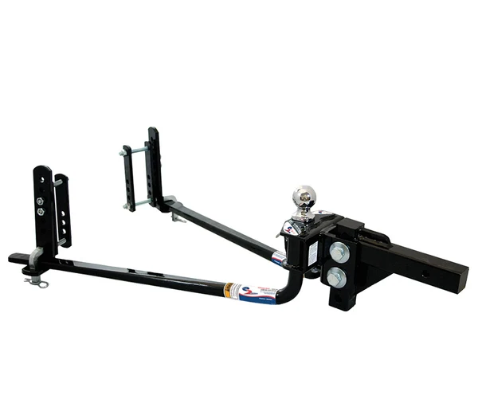
Image: A weight Distribution Hitch (WDH) is used to redistribute weight more evenly between trailer and vehicle.
Caravans are getting heavier: Bureau of Infrastructure and Transport Research Economics data shows that approximately three-quarters of newly registered caravans in Australia in 2025 had an unladen weight exceeding 2,500 kg, with caravans between 2,500 kg and 3,000 kg now representing over 30% of registrations. Therefore, audit your rig's total loaded weight before every trip. The 80% rule is your safety floor: industry towing experts widely recommend not exceeding about 80% of your vehicle's rated towing capacity to provide a safety margin for real-world conditions. If you are routinely near the limit, a GVM upgrade is the appropriate next step.
GVM and GCM are different numbers: A GVM upgrade increases the Gross Vehicle Mass only; it does NOT increase the Gross Combined Mass (GCM) or Braked Towing Capacity (BTC). Know both figures before you modify.
Mirror compliance is not optional: Under Australian Design Rules, if your caravan or trailer is wider than your tow vehicle's body you must fit extended towing mirrors, these are a legal, safety-critical requirement for safe towing on Australian roads.
| Upgrade | Best For | Effort Level | Time to Results |
|---|---|---|---|
| Extended Towing Mirrors | Anyone towing a wide caravan | Low | Same day |
| Weight Distribution Hitch | Mid-to-heavy loads causing rear sag | Low-Medium | One afternoon |
| Electric Brake Controller | Any trailer over 750 kg GTM | Medium | One day |
| GVM Suspension Upgrade | Overloaded payload, accessories fitted | High | 1-3 days (certified) |
| Anti-Sway Bar / Sway Control | Highway towing at speed, crosswinds | Low-Medium | One afternoon |
Start here if you are:
First-time caravan tower: Fit extended mirrors and a weight distribution hitch before your first trip, fastest safety gains for least spend.
Regular highway tourer: Prioritise a certified electric brake controller and sway control, which directly reduce stopping distances and trailer oscillation.
Fully kitted-out 4WD owner with accessories: A GVM upgrade is the correct pathway to restore legal payload margin and protect your insurance coverage.
For heavy towing in Australia, understanding the relationship between Gross Vehicle Mass (GVM) and Gross Combined Mass (GCM) is critical, these limits dictate how much weight you can safely carry in the car while simultaneously towing your caravan. Bolt on a steel bull bar, roof rack, long-range fuel tank, and a 300 kg tow ball weight and you can exceed your factory GVM alarmingly quickly.
A GVM upgrade gives you a bigger legal scale to work with on the vehicle side, which is particularly important for four-wheel-drive enthusiasts who love accessories, a steel bullbar and a roof rack can quickly eat up 150 kg of payload, and once you add a 300 kg tow ball weight, you are suddenly very close to the limit.
According to Ultimate Suspension, GVM upgrades are independently engineered and tested suspension solutions that allow a legal increase in payload beyond manufacturer limitations, and can provide improvements in load-carrying capacity, ride and handling, and better towing stability. Critically, they must be installed and certified correctly to remain legal. TJM's XGS GVM Plus notes that a GVM Plus upgrade removes the potential of having insurance claims denied in the event of an accident when a vehicle is over its legal GVM. That protection alone is worth the investment.
Pro Tip: Always use a licensed, ADR-compliant installer for GVM work. A suspension lift on its own does not increase your legal GVM rating, only a certified upgrade does. Confirm the paperwork is complete before you drive away.
A weight distribution hitch (WD hitch) is a towing system designed to distribute the weight of a trailer more evenly across the tow vehicle and trailer axles, when a trailer is connected to a standard ball mount, a large portion of the trailer's tongue weight pushes down on the rear axle of the tow vehicle. The result is front-axle lift, reduced steering grip, and a pronounced sag that makes the whole rig feel loose.
By restoring load to the front axle, a weight distribution hitch improves tyre traction, stabilises braking performance, and delivers more predictable steering, especially during emergency manoeuvres. In my experience, the difference is immediately noticeable the moment you pull out of the driveway. The vehicle sits level, the steering feels connected, and you arrive at your destination far less fatigued.
A trailer anti-sway bar lowers the chance of trailer sway, a common cause of accidents when towing, by moving the trailer's pivot point closer to your vehicle's rear axle to help control side-to-side motion. This matters most on open highways where crosswinds, passing road trains, and sudden steering inputs combine to push an uncontrolled trailer into oscillation. A sway bar is a key component in a vehicle's suspension system designed to enhance stability and control, and its primary purpose is to reduce body roll during turns, which is particularly important when towing a trailer or carrying heavy loads.
According to Australian legislation, trailers with a Gross Trailer Mass (GTM) over 750 kg must have brakes, with trailers between 750 kg and 2,000 kg requiring braking on at least one axle, and trailers over 2,000 kg requiring braking on all wheels. For trailers over 2,000 kg GTM, the brakes must also be operable from the driver's seated position, which means an electric brake controller is a legal requirement, not an optional extra.
In Australian conditions, heat, long descents, corrugations, and heavy loads, your brake controller plays a critical role in keeping everything under control, and is responsible for matching caravan braking to vehicle braking, improving stopping distance, preventing trailer push, reducing brake wear, and maintaining control on descents.
According to towing industry experts, electric brake controllers add extra braking power and reduce brake wear on the tow vehicle by distributing braking force across both vehicle and trailer. If you are currently using a time-delayed (non-proportional) controller, upgrading to a proportional unit that reads actual vehicle deceleration is a meaningful safety improvement, not a minor tweak.
Pro Tip: Proportional brake controllers respond to your actual braking force rather than a pre-set time delay. On long downhill runs in the Australian high country or on wet boat ramps, the difference in stopping distance is significant. Budget around $250-$600 for a quality proportional unit professionally installed.
Under Australian Design Rules (ADR), if your caravan or trailer is wider than your tow vehicle's body, excluding standard mirrors; you must fit extended towing mirrors that allow a clear, unobstructed view along both sides of the trailer and to the rear.
Failure to comply can result in fines and penalties that vary by state, and law enforcement can issue on-the-spot fines if they determine your mirrors are inadequate. Beyond the fine, inadequate visibility when towing significantly increases accident risk on lane changes, in reversing situations, and when overtaking.
I've found that the most common mistake first-time caravan owners make is assuming their standard factory mirrors are sufficient. They rarely are once you hitch up a van wider than your vehicle. Quality brand-specific clip-on or vehicle-specific replacement mirrors are your two main options, the latter typically provide far better stability at highway speeds.
Confusing a suspension lift kit with a certified GVM upgrade; they are legally distinct products.
Purchasing a brake controller rated for fewer axles than your trailer requires.
Fitting aftermarket accessories (bull bar, roof rack, drawer system) without recalculating remaining payload against your GVM.
Assuming mirrors from a previous tow vehicle will fit or comply on a new, wider caravan.
Towing at or above 100% of your rated capacity and relying on "it's always been fine" as a safety strategy.
A GVM upgrade helps you avoid suspension sagging, poor handling, and stability issues when carrying heavy loads, but a GVM upgrade only increases the Gross Vehicle Mass and does NOT increase the Gross Combined Mass (GCM) or Braked Towing Capacity (BTC). Put simply, it gives you more room to add accessories and occupants without exceeding your payload limit, but your maximum tow rating stays the same unless you also pursue a certified BTC upgrade.
Yes, in most cases. National towing regulations implemented across Australia in December 1998 decided that any camper trailer with a Gross Trailer Mass exceeding 750 kg must be fitted with an electric brake control system. Fines for non-compliance vary by state, and an uncontrolled incident involving your trailer could also void your insurance.
If towing a trailer causes your vehicle to sag in the rear, lift at the front, or feel unstable, especially when the trailer's weight approaches your tow vehicle or receiver hitch limits. A quick pre-trip check: park on level ground, hitch up your van, and look at whether your tow vehicle sits level. If the rear squats visibly, a weight distribution hitch should be your next purchase.
Clip-on towing mirrors can generally be fitted without professional help, provided they are secure and do not vibrate at speed. In reality, most full-size touring caravans require extendable towing mirrors to meet legal and safety standards, and although legislation wording varies slightly between states, enforcement is consistent with the requirement that visibility must be sufficient to safely monitor traffic behind and beside the vehicle. Vehicle-specific replacement mirrors that integrate with your existing mirror housing provide superior stability and are recommended for regular tourers.
Whether you are planning your first lap of Australia or upgrading an existing setup, the team at TCA: Trailer Camper Australia.
Caravan and Camping Data, Tourism Research Australia. Caravan and campervan registration statistics showing 938,000 registered in 2025, a 32% increase since 2019. https://www.tra.gov.au/en/tourism-statistics/caravan-and-camping-data
How Caravans Have Outgrown the Pickups Built to Tow Them, Ford Australia / BITRE. Bureau of Infrastructure and Transport Research Economics data on caravan unladen weights and registration trends in 2025. Bureau of Infrastructure and Transport Research Economics data
XGS GVM Plus, TJM. Certified GVM upgrade kits for Australian four-wheel-drive vehicles, including insurance compliance benefits. TJM's XGS GVM Plus
These are placeholder FAQs -- replace via the "custom.article_faqs" metafield.