0 item(s)
View cart
You have no items in your shopping cart.
There are now more than 937,000 registered caravans and RVs on Australian roads, according to the Caravan and Camping State of the Industry Report 2026, a figure that has grown 27% since 2019. Clearly, Australians have fallen hard for life on the road. But scroll through any caravanning Facebook group, and you'll find a recurring theme: first time caravan buyers who wished they'd known a few critical things before signing the paperwork. This guide collects those hard-won lessons so you can skip the expensive detours and get straight to the good part.
Your tow vehicle comes first: According to Carsales' towing weights guide, at least 80% of caravans on Australian roads are overweight. Know your vehicle's braked towing capacity before you even browse caravans.
The sticker price is just the beginning: Silvershine Chassis' 2026 cost guide confirms that hidden costs like registration, servicing, insurance and storage can add thousands annually on top of the purchase price. Budget accordingly before you buy.
Layout matters more than size: First-time buyers frequently discover that a showroom floor plan that looks ideal does not always translate to comfort on the road. Walk through a layout imagining a rainy day inside, not just a sunny inspection.
Insurance is not optional: Caravan insurance in Australia can range from $862 to over $2,387 per year for a newer van. Factor this into your total budget from day one.
Do a pre-trip weighbridge check: We strongly recommend visiting a weighbridge before your first trip, with full water tanks and all gear loaded, to confirm you're within legal limits.
| Step | What to Do | Effort Level | Time Frame |
|---|---|---|---|
| 1. Know your tow limits | Check your vehicle's braked towing capacity in the owner's manual | Low | 30 minutes |
| 2. Set a total budget | Purchase price plus insurance, rego, servicing and storage | Low | 1-2 hours |
| 3. Define your travel style | Weekend trips, family holidays or extended touring? | Low | An afternoon |
| 4. Choose van type | On-road, semi off-road or full off-road? | Medium | 1-2 weeks |
| 5. Research layouts | Visit showrooms and walk through multiple floor plans | Medium | 2-4 weeks |
| 6. Pre-purchase inspection | Compliance plate, weights, water damage, tyres | High | Before signing |
Start here if you are:
A complete beginner: Step 1 is non-negotiable. Your tow vehicle caps everything else.
Buying used: Jump straight to Step 6, a professional pre-purchase inspection is critical.
Planning off-road adventures: Prioritise Step 4 above layout. A van that cannot handle your terrain is a van that stays in the driveway.
This is the single most common and most dangerous mistake in the caravan world. In my experience talking to new owners, most people shop for a caravan they love and then check whether their car can tow it, when it should be the other way around, every time.
The simplest way to determine what your car can tow is by comparing your vehicle's maximum braked towing capacity with the caravan's Aggregate Trailer Mass (ATM). Your car's capacity must be equal to or greater than the caravan's fully loaded ATM for you to be safe and legal on Australian roads.
Failure to get this right can lead to dangerous instability on the road, voided insurance, and hefty fines. That is not a small consequence. If you cause an accident while towing over your vehicle's rated capacity, your insurer may walk away from the claim entirely.
According to weighbridge expert Richard, "at least 80% of caravans are over-weight," and the most overloaded van he has seen was 1.2 tonnes over legal limits. If 80% of caravans already on the road are overweight, imagine how many owners bought without properly checking. Do not be one of them.
Pro Tip: Before buying, check your vehicle's owner's manual for two figures: the braked towing capacity and the tow ball mass rating. The tow ball mass is often overlooked but equally important, RAC WA's towing guide notes that ball mass is typically 10% of the van's ATM, and this figure is deducted from your vehicle's own payload capacity.
The golden rule for caravanning is to keep the caravan's loaded weight at no more than 85% of your car's towing capacity for extra safety. This buffer exists because manufacturer limits are absolute maximums, tested under ideal conditions. The max braked tow capacity is a maximum, and no vehicle is designed to do it day-in, day-out, particularly not in hot conditions, when modified, or slugging up and down hills.
Practically, this means if your car has a 3,000 kg braked towing capacity, target a caravan with a fully loaded ATM no higher than around 2,550 kg. That headroom could save your life on a steep descent in 35-degree heat.
In Australia, all you need is a full driving licence for the tow vehicle you are driving. A learner or P1 probationary driver is not usually allowed to tow a caravan except under particular conditions.
When towing, you must not tow more than one trailer at a time, must not have any person travelling in the caravan being towed, and must secure and cover your load. Every state and territory has its own set of rules for towing, so make sure you know the specifics, including speed limits, licensing, and weight restrictions, before you hit the highway.
The purchase price of a caravan is just the entry fee. I've found that most first-timers budget carefully for the van itself and then get a nasty surprise once they're actually in ownership.
The average Australian family typically spends between $70,000 and $120,000 on a mid-range caravan. But the ongoing costs stack up quickly:
Insurance: Camper trailers run $250 to $500 per year, mid-range caravans $500 to $1,200 annually, and luxury caravans $1,000 to $5,000 or more annually. Therefore, before you fall for a top-spec off-road van, confirm you can also afford to insure it properly.
Servicing: Routine servicing is essential for longevity and typically costs $400 to $800 per year. All caravans, including rarely used ones, must go through annual service. Caravans should be checked within the first 12 months from purchase, and servicing should be done every 12 months or 10,000 kilometres after that.
Storage: Outdoor storage typically ranges from $80 to $250 per month depending on location and security, while secure indoor facilities cost more. In metropolitan areas, annual storage can exceed $2,000.
Depreciation: Like any vehicle, caravans depreciate over time, with the average annual depreciation running 8 to 15%, depending on condition and usage.
Pro Tip: When building your total-cost budget, add at minimum $3,000 to $5,000 per year in running costs on top of any finance repayment. If that figure makes the purchase uncomfortable, consider a smaller van or a quality used model, 7th Street Caravans' buying guide notes that used caravans can cost 20 to 40% less than new, though they need a professional inspection first.
Your current car may not be rated to tow the caravan you want, meaning you may need to upgrade your vehicle or add a tow bar, wiring harness, or weight distribution hitch. For the job of towing a modern caravan, you will likely be looking at dual-cab utes and large SUVs. You can get away with a medium SUV for towing a lightweight camper trailer, but for the comfortable home-away-from-home vans, you will need something beefier.
A weight distribution hitch, brake controller, towing mirrors and suspension upgrades can easily add another $2,000 to $4,000 before you have even hitched up the van for the first time.
After years of watching new buyers make this mistake, I can say with confidence: the floor plan that looks amazing during a 20-minute showroom visit often feels completely wrong after three days on the road. The showroom is quiet, clean and empty. The road is not.
Match the layout to who travels and how. Couples can go lighter and shorter, families need bunks and bathroom space, and full-timers want storage and living area. A longer van tows and parks differently, so size is a towing decision as much as a comfort one.
Walk through a few layouts imagining a rainy day inside, not just a sunny inspection. Where do wet boots go? Can two people pass in the kitchen? These are the questions that separate the right van from an expensive regret.
According to retailers, the most popular caravan today is a 15 to 16ft pop-top with front kitchen, island double bed at the rear and an L-shaped dinette at one side with a small lounge seat opposite. This layout works well for couples and short trips, but is it right for you?
Couples: Couples might prioritise luxury and convenience in a more compact space, with comfortable sleeping arrangements like a large fixed bed or convertible seating area.
Families: Look for layouts with multiple sleeping areas such as bunk beds or convertible dinettes, plus ample storage for clothes, toys and travel essentials.
Grey nomads and full-timers: Storage is king. You will live in this space for weeks at a time, so prioritise a separate bathroom, generous pantry space and a comfortable lounge area you would genuinely want to spend a rainy afternoon in.
Pro Tip: If you are considering a camper trailer as an entry point into the lifestyle, perhaps before committing to a full caravan, Trailer Camper Australia (TCA) stocks the Austrack range of off-road camper trailers and hybrid caravans from their Canberra showroom, covering everything from lightweight forward-fold options for couples through to family-sized hybrid models. Their on-site team installs brake controllers, solar systems and suspension upgrades, meaning you can see, touch and spec up your first rig in one place.
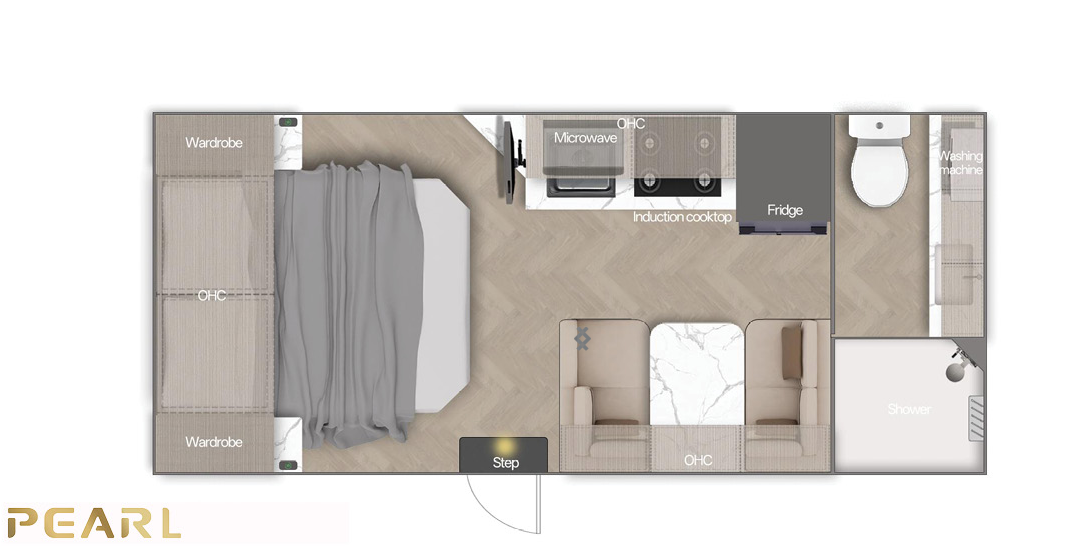
Image: Layout of Zodiac, Pearl Offroad Caravan
This is where first time caravan buyers tend to get caught in analysis paralysis. The honest answer is that both options can work; it just depends on your risk tolerance and inspection skills.
New caravans have all the benefits of brand-new safety features and the comforts of up-to-date design, including things like independent rear suspension and durable, lightweight construction materials. You can also customise floor plans and the level of specification right down to your favourite taps, kitchen laminate and details.
A cheaper caravan can be tempting but build quality matters far more over time. Chassis design, suspension, cabinetry construction and component selection all influence durability, safety and resale value.
Used caravans can cost significantly less than new models, but condition, service history and water ingress risks need careful inspection. Factor in on-road costs, registration, potential dealer delivery fees and any required upgrades to your tow vehicle.
When buying used, inspect thoroughly for water damage, rust and outdated compliance plates. Water damage is the silent killer of used caravans. It often hides behind wall panelling and in roof cavities, causing structural rot that is expensive to repair and nearly impossible to spot without a professional inspection. Always budget for one before you sign.
Even buyers who research carefully tend to make a handful of the same errors. Here is what I have seen trip people up time and time again.
The Caravan Council of Australia has been advised of numerous instances where defects have been found on new caravans manufactured in recent years. If defects turn up on new vans, the risk on used ones is considerably higher. A professional pre-purchase inspection costs a few hundred dollars and can save you tens of thousands.
Do not just think about the first trip, plan forward a couple of years. Will your caravan be mainly used for weekend escapes? Is it for family holidays with the kids? Or for a long-term lap of Australia? A van that suits a weekend warrior does not suit a retiree planning six months on the road.
A caravan with insufficient payload can limit how you travel or leave you unknowingly over legal limits. Understanding weights upfront allows you to travel safely, confidently and compliantly. The payload is the difference between the van's tare weight and its ATM, and it fills up faster than you think once you add water, food, camping gear, bikes and tools.
Caravan insurance is one of those ownership costs people often research after they have fallen in love with a caravan. By then, they are already thinking about the layout, the tow vehicle and the weekend trips. But insurance is worth thinking about earlier, because it helps you understand the full cost of owning a caravan properly.
In most cases, no. All you need is a full driving licence for the tow vehicle you are driving. A learner or P1 probationary driver is not usually allowed to tow a caravan except under particular conditions. However, every state and territory has its own set of rules for towing, so check your specific state authority before heading off.
The cost of caravan insurance in Australia for a newer caravan can range from $862 to over $2,387 per year, with an average of $1,822.88 per year. Premiums vary based on the van's value, where it is stored, and how often you travel off sealed roads. Get at least three quotes before committing to a policy.
All caravans, including rarely used ones, must go through annual service. They should be checked within the first 12 months from purchase, and servicing should be done every 12 months or up to 10,000 kilometres after that. Budget between $400 and $1000 per year for routine servicing, with older or more complex vans likely to cost more.
ATM stands for Aggregate Trailer Mass; it is the maximum your caravan can legally weigh when fully loaded. Tare weight is the weight of the van when empty from the factory. The ATM of your chosen caravan cannot exceed your vehicle's specified towing capacity. The ATM is the maximum weight of the loaded caravan when carrying the maximum allowed payload, including water, fuel, food, clothes, annexes and accessories.
For many first-time buyers, a camper trailer is an excellent entry point into the lifestyle. It costs significantly less, weighs considerably lighter (meaning more vehicles can tow one legally), and teaches you how you actually like to travel before you commit to a larger purchase. Camper trailers offer freedom versatility and flexibility, and with options at a range of price points, you can find a tough, well-featured model without a large outlay. With both hard floor and soft floor options available, there is a camper trailer to suit couples looking for adventure and families planning a longer trip.
Whether you are starting with a lightweight forward-fold camper or stepping straight into a full hybrid caravan, the fundamentals never change: know your tow limits before you browse, budget for the real total cost of ownership, and choose a layout for how you will actually live in it. Trailer Camper Australia (TCA) is an Australian-owned business supplying camper trailer, caravan and 4WD touring parts to travellers across the country. From their Fyshwick showroom in Canberra, they stock over 12,000 product lines including couplings, suspension kits, 12V power, solar, fridges, awnings and recovery gear, alongside Austrack off-road campers and hybrid caravans. Their on-site workshop installs brake controllers, solar and battery systems, and suspension upgrades.
Browse the Trailer Camper Australia showroom range to explore Austrack campers and hybrid caravans, or visit the Canberra showroom to walk through your options in person.
Caravan and Camping State of the Industry Report 2026, GoRV / Caravan Industry Association of Australia. RV registrations, market data and production figures. https://www.gorv.com.au/state-of-the-australian-caravan-industry/
Towing Weights Explained: How to Legally and Safely Tow a Caravan, Carsales Australia. Braked towing capacity, weight limits and overloading statistics. https://www.carsales.com.au/editorial/details/towing-weights-explained-how-to-legally-and-safely-tow-a-caravan-in-australia-150480/
What Can My Car Tow? An Australian Caravan Weight Guide, The Caravan Database. ATM vs towing capacity explained. https://thecaravandatabase.com/articles/what-can-my-car-tow-an-australian-caravan-weight-guide
Towing a Trailer or Caravan, NSW Government. Legal towing rules, licence conditions and safety standards. https://www.nsw.gov.au/driving-boating-and-transport/roads-safety-and-rules/vehicle-safety-and-compliance/towing-a-caravan
How to Tow a Caravan: A Beginner's Guide, RACV. Vehicle selection, braked towing capacity and beginner tips. https://www.racv.com.au/royalauto/transport/caravans-trailers/towing-for-beginners-what-to-know.html
How Much Does Caravan Ownership Really Cost in Australia?, What's Up Down Under. Insurance, servicing, storage and depreciation costs. https://whatsupdownunder.com.au/plan/buyers-guide/caravan-ownership-costs-australia/
Trailer Camper Australia (TCA), Trailer Camper Australia. Austrack camper trailers, hybrid caravans and touring accessories. https://trailercamperaustralia.com.au/
These are placeholder FAQs -- replace via the "custom.article_faqs" metafield.