1 item(s)
View cart

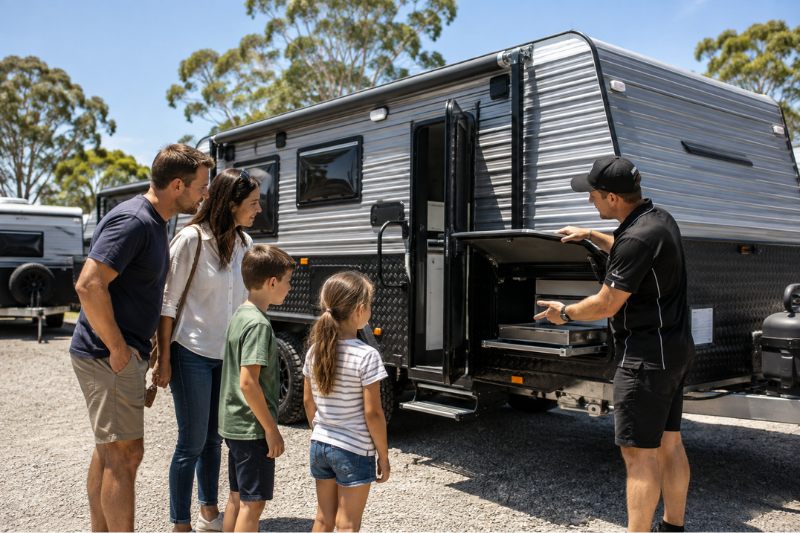
A camper trailer is a five-year, five-figure decision for most Australian families — and the difference between a good buy and a regretted one usually comes down to five or six practical calls made before you sign. This camper trailer buying guide is written for parents making their first (or second) purchase: the ones who want a family setup that tows behind the existing 4WD, sleeps everyone realistically, handles a school-holiday loop off-grid, and doesn't blow the budget on capability nobody will use. We'll cover tow numbers, layout, off-grid electrics, and the honest cost of ownership.
Match the camper trailer type to how your family actually travels
Forward-fold campers open like a book from the drawbar, giving you a large canvas tent and a fast setup — great for weekends inside three hours of home. Dual-fold campers open both ways, adding sleeping space at the cost of a longer setup. Hybrid off-road campers look like small caravans, keep the family dry in a downpour, and hold the water and lithium capacity for a proper remote trip. Rooftop tents suit couples or families with older kids doing minimal-footprint touring.
For most Australian families the pick is a forward-fold for weekend use or a family hybrid (like the Stockton X7) if school-holiday touring is on the calendar. Buy the format your typical trip actually needs — not the one your dream trip needs.
Get the tow numbers right before you buy
Any honest camper trailer buying guide starts here, because more families get burned by tow-vehicle mismatch than by any other single mistake. Learn four numbers before you walk into a showroom:
- Your vehicle's braked towing capacity — the max weight your car is rated to tow (Prado, Everest, MU-X typically 3,000–3,500 kg; Ranger, Hilux, D-Max 3,500 kg)
- Your vehicle's GVM and rear-axle rating — the max total weight of the loaded tow vehicle and how much the rear axle can carry
- The camper trailer's ATM (Aggregate Trailer Mass — the max the trailer can weigh loaded)
- The camper trailer's Ball weight — the download onto your tow ball, typically 8–12% of ATM
If the trailer's ATM is close to your car's braked capacity, you're at the edge. If Ball weight pushes past your car's rear-axle limit once you load the boot, you're overloaded before you leave the driveway. Bring your car's compliance plate details to the showroom and ask the salesperson to run the numbers with you — a good dealer will do this openly.
Sleeping capacity, storage, and what "family layout" really means
A 6-berth camper trailer isn't the same product as a 2-berth with different bedding. Look at the actual sleep configuration:
- Main bed — is it a proper island queen, or a fold-out that needs to be made every night?
- Bunk beds — full-length for teenagers, or short-bunk for kids under 10?
- Convertible dinette — great for kids, less great for two adults
For a family of four with primary-school kids, a family hybrid with a queen main bed and a bunk conversion (or an internal drop-down bunk) works well. For a family of five or teenagers, look at layouts with dedicated bunks that don't need to be rebuilt at every camp. Storage is the other silent decider — check external hatches for bikes, boogie boards, or a portable toilet, and count internal drawers for bedding and clothes for the whole trip.
Two practical tips before you commit to a layout: lie down on the main bed at the showroom (not just look at it) and ask about awning length. On a wet school-holiday morning, an awning long enough to keep the door and half your camp chairs dry is the difference between a great trip and a miserable one — an anti-flap kit with side walls is worth budgeting for at purchase, not later.
Off-grid capability without over-buying
Off-grid electrics have got cheaper and better fast, and it's tempting to buy the biggest lithium bank on the market. Match capability to trip length:
- Weekend camping (2–3 nights, powered park or generator available) — 100–150 Ah battery, 100–200 W solar is plenty
- Week-long off-grid holiday (4–7 nights, no shore power) — 200–300 Ah lithium, 300–500 W solar
- Extended remote touring (10+ nights, Cape York / Kimberley loops) — 400 Ah+ lithium, 500 W+ solar, dual water tanks
For a family of four running a 12V fridge, phone chargers, and camp lights, a 200–300 Ah lithium bank with 300–500 W of solar handles a school-holiday trip comfortably. Anything larger is future-proofing you might not use — spend the difference on layout, tyres, or a decent awning instead.
Water is often the tighter constraint. A family of four with typical camp discipline uses 20–30 L per day for cooking, drinking, hand-wash and quick showers. A single 80 L fresh tank runs three days; two 80 L tanks (160 L total) gives you a week's headroom before you need to top up at a station or a bore. If the camper carries a grey-water tank as well, you can free-camp in places that don't allow greywater to hit the ground — a growing consideration in national parks.
Budget, finance, and total cost of ownership
Family camper trailers cluster in two bands: $30–45K for a forward-fold or dual-fold that handles weekends and short trips, and $48–65K for a family hybrid that handles school holidays and moderate off-grid work. TCA's caravans and camper trailers range spans both bands; the family-focused Stockton X7 sits at the top of the forward-fold segment and takes over from where a smaller unit ends.
Finance for camper trailers in Australia is available through Austrack Finance (a separate entity) across a panel of 30+ lenders — secured and unsecured options are on the table. Budget for the ongoing costs too: registration and insurance in most states runs $600–1,200/year, and camper trailer tyres, wheel bearings, and canvas re-waterproofing are the three regular service items over a 10-year ownership window.
Turning your camper trailer buying guide into a shortlist
By this point your camper trailer buying guide has narrowed to five practical numbers: your tow vehicle's braked rating, the camper's ATM and Ball weight, the number of berths your family actually needs, the off-grid duration you'll typically want, and your budget band including accessories. Write those five down before you visit a showroom — a good dealer will walk through them with you and put the right two or three models in front of you rather than the whole catalogue.
The final call is usually made in person. Sit inside the shortlisted campers with your partner, open every hatch, ask about lead time on stock, and confirm what warranty covers in year one, three, and five. If the deal stacks up, ask about a delivery date that lets you do one shakedown weekend inside three hours of home before the first big holiday trip — every camper reveals its small quirks in the first 48 hours of use.
Frequently Asked Questions
What's the best camper trailer for a family of four or five?
For a family of four, a family hybrid like the Stockton X7 hits the sweet spot — six berths, electric roof, ensuite privacy room, and a mid-size 4WD can tow it. For five, look at the same hybrid category but confirm the bunk configuration handles three kids without a convertible dinette in the mix.
Do I need a 4WD to tow a family camper trailer?
Not necessarily. Many forward-fold family campers with an ATM under 1,800 kg tow behind a Territory, Kluger, or similar 2WD with a 2,000 kg braked rating. If you want a hybrid off-road camper or plan gravel-road access to remote sites, a proper 4WD with a 3,000 kg+ tow rating (Prado, Everest, MU-X, Ranger) is the safer choice.
How long can a family camp off-grid in a modern camper trailer?
A well-specified family hybrid with a 200–300 Ah lithium bank, 300–500 W solar, and 150 L+ of fresh water can support a family of four for a full week off-grid, assuming reasonable water discipline and standard 12 V fridge use. Longer trips need the 400 Ah+ setups sized for full remote touring.
What's a realistic first-time family camper trailer budget?
Plan for the camper trailer itself plus about 10–15% on top for essentials — a set of jerry cans, a portable toilet, an anti-flap kit, decent tie-down straps, a spare tyre and a wheel-brace that fits it. A $50,000 camper trailer usually needs $5,000–8,000 of accessories in the first year before you're travelling comfortably.
Are camper trailers better than a caravan for families?
Different jobs — and the honest camper trailer buying guide answer is "it depends on your family stage". A camper trailer is lighter to tow (opens up more tow-vehicle options), cheaper to buy, and easier to store at home. A caravan is heavier and pricier but needs no setup on arrival, keeps you sealed in weather, and holds a fixed bed. Families with young kids often start with a camper trailer for the flexibility, then upgrade to a caravan when the kids are teenagers and setup fatigue matters more.
Ready to move your camper trailer buying guide from the desk to a real inspection? Book a walk-through at our Fyshwick ACT showroom (Mon–Fri 8:30–5, Sat 9–2), or use Request a Quote on any product page — we'll have the roof up and the kitchen deployed before you arrive.
 Toby Lewis
Frequently Asked Questions
What will I learn from this article?
This post covers the complete camper trailer buying guide for australian families -- read through for the full breakdown, and check out the related posts below for more on this topic.
Where can I ask a follow-up question?
Leave a comment below, or contact our support team if you'd like help applying this to your own setup.
These are placeholder FAQs -- replace via the "custom.article_faqs" metafield.