0 item(s)
View cart
You have no items in your shopping cart.
If you have ever arrived at camp with a flat auxiliary battery despite driving for three hours, a DC-DC charger is the device that fixes that problem permanently. A DC DC charger converts power from a vehicle's alternator to safely charge a secondary battery. For anyone towing a camper trailer, running a 12V fridge, or exploring remote parts of Australia, understanding this technology is the difference between a comfortable trip and a frustrating one.
Modern touring setups, dual batteries, lithium house banks, solar on the roof, 12V fridges, inverters, ask a lot from your electrical system. At the same time, modern vehicles use smart alternators that do not always provide a steady charging voltage. Therefore, relying on a simple wire connection from your tow vehicle to your camper's battery is no longer good enough. A DC DC charger is the smart bridge that keeps everything topped up while you drive.
The DC-DC charger wired to your vehicle's alternator allows you to charge your caravan or camper battery whilst you drive.
A DC-DC charger converts voltage between batteries: It converts one DC voltage from your vehicle to another DC voltage in order to charge a battery, ensuring your auxiliary battery receives exactly what it needs.
Smart alternators make a DC DC charger essential: Most modern vehicles with start-stop technology use smart alternators. Most vehicles manufactured from 2015 onwards have smart alternators, meaning a basic relay connection will leave your aux battery undercharged.
Multi-stage charging protects your battery: Without proper multi-stage charging, an AGM battery will stop accepting charge at around 80% state of charge and a lithium battery will never hit its full capacity. If your battery regularly tops out at 80%, upgrade to multi-stage charging immediately.
Driving time matters, so does charger size: A 40A charger restores up to 30Ah more than a 25A charger after just two hours of driving. If your typical driving leg is under three hours, a larger charger pays for itself quickly.
Solar and DC charging work together: DC DC chargers are especially effective when paired with solar panels that can charge your batteries even when the vehicle is turned off.
| Setup Type | Best Charger Option | Effort Level | Time to Results |
|---|---|---|---|
| Weekend camper, AGM battery, short drives | 20-25A DC DC charger | Low | Immediate |
| Regular tourer, lithium battery, mixed drives | 25-40A DC DC + MPPT solar input | Medium | 1-2 drive days |
| Serious off-grid setup, large battery bank | 40-50A DC DC + dedicated solar MPPT | Medium-High | First outing |
| Full-time camper, high power draw | 50A+ DC DC + battery management system | High | Requires install |
Start here if you are:
A first-timer: A 25A unit handles most camper trailer setups and is straightforward to install. Browse the DC DC charger range at Trailer Camper Australia to find options that suit your battery size.
Running lithium batteries: Choose a charger with a dedicated lithium charging profile, the wrong profile can damage lithium cells permanently.
Upgrading from a relay or VSR: Any DC DC charger is a major improvement. Prioritise one with smart alternator compatibility.
A DC DC charger, also referred to as a battery-to-battery charger, takes the output from your primary battery and utilises optimal charging to charge your secondary battery. Think of it like a smart translator sitting between your vehicle's electrical system and your camper's house battery. The vehicle speaks one electrical "dialect" and the house battery speaks another, and the DC DC charger makes sure they understand each other perfectly.
It works by converting the input voltage from the source battery to the required output voltage for charging the target battery. A DC DC battery charger is a device that allows you to charge one battery from another battery, typically with different voltage levels. In a practical camping context, that means your tow vehicle's alternator charges your starter battery, and the DC DC charger takes that power and re-delivers it at the precise voltage and current your camper's auxiliary battery requires.
The charger consists of several components including a DC-to-DC converter, control circuitry, and sometimes a voltage regulator. The DC-to-DC converter is responsible for stepping up or stepping down the voltage as needed. This conversion may involve using switching techniques such as pulse width modulation (PWM) or buck-boost converters.
The DC DC charger measures the input voltage from the vehicle's alternator to determine its level and adjusts the charging process accordingly. It converts the input voltage from the alternator to the required charging voltage for the house batteries. It ensures that the batteries receive a stable and regulated charging current, preventing overcharging or undercharging.
Pro Tip: A DC DC charger does not care if your alternator voltage fluctuates. Charging will always take place when the engine is running, regardless of the alternator output voltage, because low voltages are boosted to meet the required charging profile. This makes it far more reliable than a simple relay in any modern vehicle.
Modern cars have systems such as 'Smart Charge' where they reduce the voltage output of the alternator when the car warms up or detects that the car's main battery is at a certain voltage. If you have upgraded to lithium batteries, a DC DC charger is required, as the car's alternator cannot put out the required charging profile.
Smart alternators do not always provide the consistent power needed to charge auxiliary batteries effectively. When voltage drops below 13.2V, which happens often with smart alternators, a regular charging system might stop charging altogether, leaving you with an undercharged battery and limited power supply. The practical result: you drive for four hours and arrive at camp with a battery that is still only half full.
Vehicles with Euro 5 and Euro 6 emissions-compliant engines, essentially everything sold new in Australia from roughly 2015 onwards, use a smart alternator. If your tow vehicle was bought new in the last decade, it almost certainly has one. Check your owner's manual or ask your mechanic if you are not sure.
Before DC DC chargers were common lots of dual battery systems just used a voltage sensing relay (VSR) or simple solenoid. A VSR simply connects the two batteries together when the engine is running and disconnects when the engine is off. It does not control voltage, current, or charging stages.
A modern battery charger will monitor the battery and adjust the current to optimise the charge to match the needs of the battery. Battery isolators do not allow your battery to get a full charge. If you are still running a VSR on your camper trailer setup, you are almost certainly leaving 20% or more of your battery's capacity on the table every single trip.
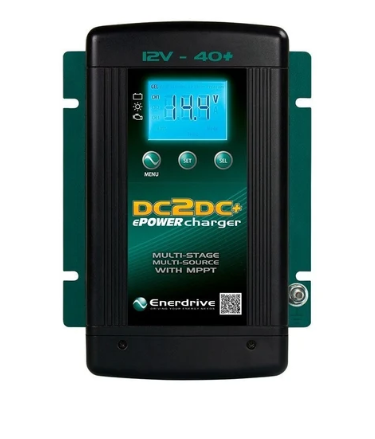
Image: Enerdrive 40A DC-DC charger with built-in MPPT Solar
For lead-acid batteries, charging generally takes place in three separate steps or stages: bulk, absorption, and float. The first step is the bulk stage, or constant current charging. During this stage, the input current to the battery is set at the maximum safe rate the battery will accept until voltage rises to near the fully charged level.
Once the battery is charged to 75-80% of its final charge, the battery charger moves to the absorption charging stage. During this stage, the input voltage to the battery is held constant while the current is gradually tapered off. Finally, the float stage maintains the battery without overcharging it.
LiFePO4 batteries are lithium batteries managed by an internal BMS, so they require tighter voltage control and a charger that knows when to stop. If you match the charger profile to the battery chemistry, you protect battery life, improve performance, and reduce the risk of premature failure.
Unlike an isolator, a DC DC charger can "boost" low alternator voltage to the 14.4V-14.6V required to 100% charge a lithium battery. If you have upgraded your camper trailer to a lithium battery and are still using a relay or unregulated charge line, you are undercharging every single time and shortening the life of an expensive battery.
Pro Tip: Do not assume your current AGM charger is safe for LiFePO4. The wrong float behaviour, prolonged absorption, or desulfation mode can shorten lithium battery life or damage the battery management system. Always select a DC DC charger that explicitly lists a lithium (LiFePO4) charging profile.
Many modern DC DC chargers include a built-in MPPT solar input, which means a single device can manage both alternator charging while driving and solar charging when parked. Smart power switching automatically transitions between solar charging in sunlight and alternator power on the road for uninterrupted energy.
MPPT technology allows the system to convert excess panel voltage into additional charging current, significantly boosting charging efficiency, often by 20-30%, especially in colder or low-light environments. That 20-30% improvement means you need fewer panels or charge faster on cloudy days. If you are not getting that gain, your solar setup is likely using an older PWM controller rather than MPPT.
For serious off-road touring, the most capable setup combines three charging sources: the DC DC charger on the road, solar on the roof while parked, and a 240V mains charger when you find a powered site. On the road, a DC DC charger keeps your house battery topped up from the alternator and solar. At home or in a caravan park, an AC DC charger brings the battery up to 100% and maintains it when connected to mains. They complement each other, one for the drive days, one for the plug-in days.
Trailer Camper Australia stocks a range of DC DC chargers with integrated MPPT solar input, including units from REDARC, a brand designed, built and tested in Australia for our unique conditions.
Pro Tip: Lithium batteries should not be charged below 0°C, and AGM batteries benefit from slightly higher charge voltages in cold weather. A charger with a temperature sensor on the battery will adjust charge voltages automatically, which matters if you tour in alpine regions in winter or the Top End in summer.
Charger size is measured in amps (A). A higher amp rating means faster charging, but it has to suit your alternator capacity and battery size. With a lead-acid battery (wet, AGM or gel), a recommended output for a charger would be somewhere in the region of 10-20% of the overall capacity. For example, if you have a 100Ah AGM battery, a charger in the region of 10-20A output is recommended.
If your 100Ah battery is completely flat, a 20A charger will take about five to six hours of continuous driving to fill it. A 40A charger will fill it in about two and a half to three hours. For most Australian tourers doing two to four hour drives between camps, a 25-40A unit hits the sweet spot.
When fitting a DC DC charger another point to consider is your alternator output in amps. The last thing you want to do is install a charger that is too large for your alternator size, as this will demand too much current, causing the alternator to overwork and eventually fail prematurely. A general rule of thumb is to keep the DC DC charger's draw at no more than 25% of your alternator's rated output.
Trailer Camper Australia's DC DC charger collection includes well-regarded options from REDARC and Enerdrive. The REDARC BCDC1225D 25A suits most light camper trailer setups with 100-150Ah battery banks, while the BCDC1240D 40A is better suited to larger lithium banks or serious off-grid rigs. For camper trailers with both solar and vehicle charging needs, the REDARC Manager30 combines a full battery management system with 30A DC DC and MPPT solar input in a single unit.
A DC DC battery charger overcomes variable voltage alternator issues and long cable voltage drop problems that are common in trailer setups where the wiring run from the tow vehicle to the auxiliary battery can be several metres long.
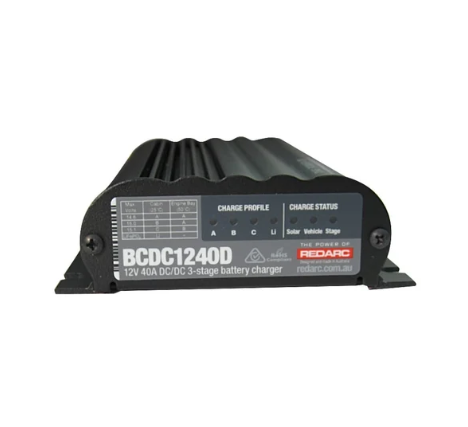
Image: Redarc BCDC1240D 40 Amp DC to DC Battery Charger MPPT Solar Input
A DC DC charger converts and regulates voltage so lithium batteries receive the correct, tailored charging profile, protecting them from overheating and extending their lifespan. Setting your charger to the wrong battery type, for instance, using an AGM profile on a lithium battery, is a common mistake that causes undercharging and can permanently damage cells over time.
For a 20A or 30A charger, you typically need 6 AWG / 16mm² wire. For 40A to 60A chargers, you need heavy-duty 4 AWG / 25mm² wire. Undersized cabling creates heat, wastes energy through voltage drop, and is a fire risk. In my experience, this is the single most common installation error, people buy a quality charger and then run it through wire that is too thin.
To optimise the DC DC charging system with a smart alternator, the IGN (ignition) wire becomes essential. Without the ignition signal wire connected, some DC DC chargers cannot reliably detect when the engine is running versus when the battery is just sitting at resting voltage. The result is the charger either failing to start or draining your starter battery when the engine is off.
A DC DC battery charger is a more sophisticated and advanced solution for dual battery systems. It provides efficient charging, multi-stage charging profiles, and fully recharges your battery. A battery isolator simply connects the two batteries together to share voltage; it has no intelligence, no stages, and will leave your auxiliary battery partially charged. For any lithium battery setup, a DC DC charger is the correct choice.
Yes. A quality DC DC charger with a proper lithium profile is what makes a lithium auxiliary system viable in a 4x4 or caravan application. Running a lithium battery without a dedicated DC DC charger means your alternator's unregulated output will never charge it properly, and you risk confusing the battery's built-in BMS, which can trigger a protection shutdown mid-trip.
This depends on charger size and battery capacity. The result of a properly installed DC DC charger is a full charge in two to four hours of driving instead of a partial charge over eight hours, when compared to an unregulated connection. A 25A charger on a 100Ah battery takes roughly five to six hours; a 40A charger on the same battery takes around two and a half hours.
A DC DC charger with solar input works with solar panels when the sun is bright and automatically switches on alternator charging when the vehicle is on, or even better, both at the same time. Units with MPPT solar input are the best option for camper trailers that also carry roof-mounted panels, as they can blend both charging sources without any manual switching.
As in a split-charge system, the starter and auxiliary batteries are electrically isolated when the engine is not running to ensure that one cannot discharge the other. A DC DC charger handles this automatically; you do not need to worry about waking up to a flat starter battery because power has drained back from the camper to the tow vehicle overnight.
In my experience, nothing transforms an off-grid camping setup more dramatically than fitting a quality DC DC charger. You stop managing power anxiety and start focusing on the trip itself. Whether you are running an AGM battery on a basic weekend camper or a 200Ah lithium bank on a full-time rig, there is a charger sized for your needs.
Trailer Camper Australia carries a curated range of DC DC chargers, from REDARC's trusted BCDC series to Enerdrive's programmable options, all suited to the demands of Australian touring. Browse the range, check the specs against your battery size, and reach out if you need a hand choosing the right unit for your setup.
 Toby Lewis
These are placeholder FAQs -- replace via the "custom.article_faqs" metafield.